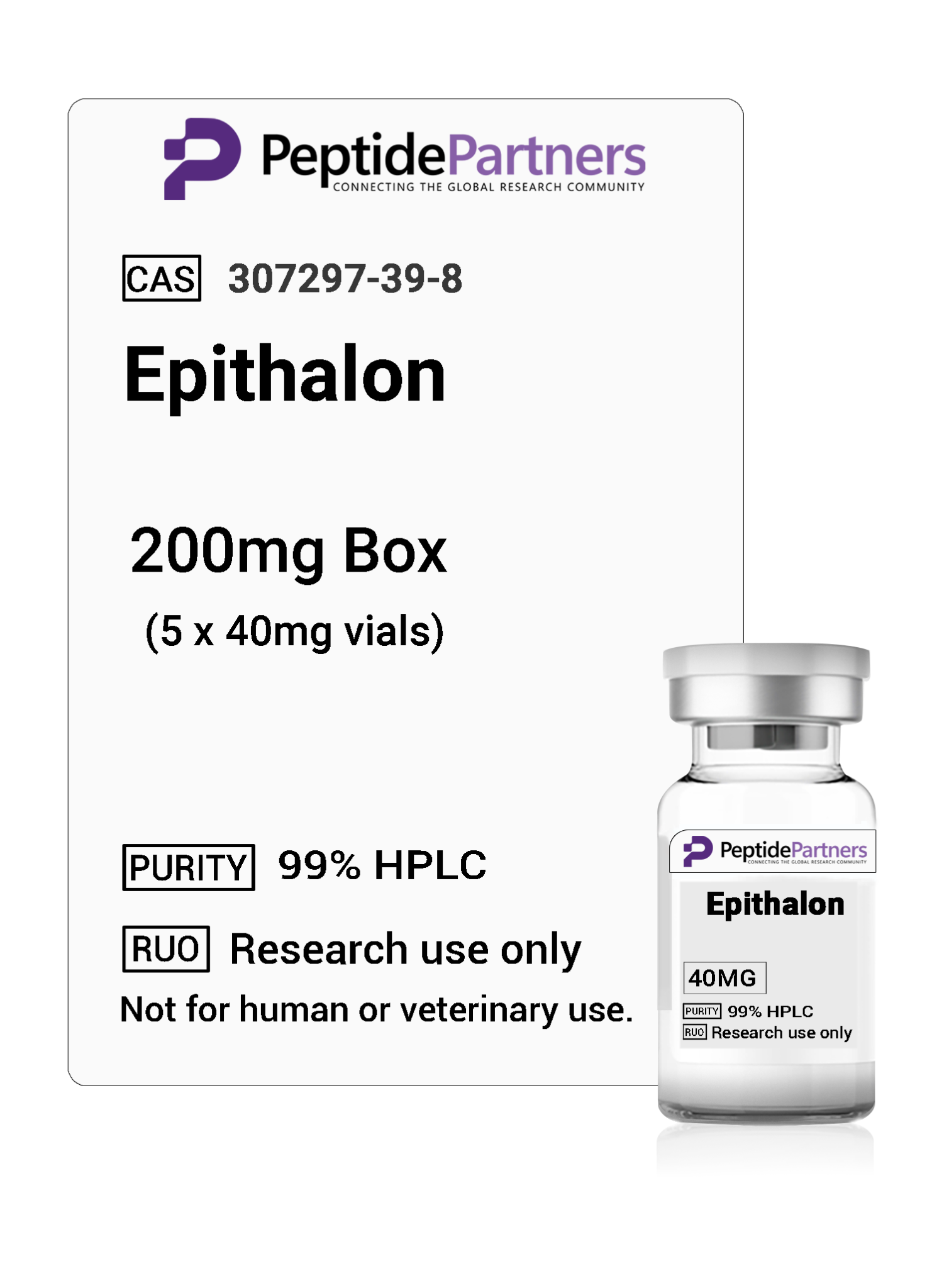
Epithalon (5 x 40mg vials)
$450.00
Discover Epithalon in 40mg vials, designed for research into mitochondrial function. Each vial contains high purity at 99.86%, ensuring reliable results for your studies. Available in convenient multi-vial packs, Epithalon supports deeper insights into cellular health. Buy now to enhance your research.
Epithalon – 40mg Vials
Swipe right to view full table →
Product Format |
40mg vials |
Vial Size |
40mg |
Vial Capacity |
3 mL |
Box Combinations |
80mg, 200mg, 400mg |
Cost per milligram |
$1.98 – $2.70 |
Multi-vial Purity |
99.86% |
Endotoxin Screening |
PASSED |
Heavy Metals Screening |
PASSED |
Purity Screening |
PASSED |
Independently Tested |
YES |
Peptide Partners Manufacturer Id: WF03
Batch Id: ET202604
Research Studies
(for educational purposes only)
Epitalon Protects Against Post-Ovulatory Aging-Related Damage of Mouse Oocytes In Vitro
Authors: X. Yue, S. Liu, J. Guo, T. Meng, X. Zhang, H. Li, C. Song, Z. Wang
Publication: Aging, 2022
URL: https://pubmed.ncbi.nlm.nih.gov/35413689/
Scientific Summary
This in vitro study evaluated Epitalon, also known as Epithalon, in a mouse oocyte aging model. The researchers added Epitalon to the culture medium and assessed oocyte quality across 6, 12, and 24 hours of post-ovulatory aging. Epitalon treatment reduced intracellular reactive oxygen species, decreased spindle defects and abnormal cortical granule distribution, and increased mitochondrial membrane potential and mitochondrial DNA copy number. The authors reported that these effects were associated with reduced apoptosis during the in vitro aging window and suggested that Epitalon may delay oocyte aging through modulation of mitochondrial activity and oxidative stress.
Plain English Interpretation
This was a controlled laboratory study, not a human-use trial. In cultured mouse egg cells, Epithalon was associated with lower oxidative stress and better preservation of several cellular quality markers during aging outside the body. The main research takeaway is that Epithalon may interact with mitochondrial and oxidative-stress pathways in cell-culture conditions.
AEDG Peptide (Epitalon) Stimulates Gene Expression and Protein Synthesis During Neurogenesis: Possible Epigenetic Mechanism
Authors: V. Khavinson, F. Diomede, E. Mironova, N. Linkova, S. Trofimova, O. Trubiani, S. Caputi, B. Sinjari
Publication: Molecules, 2020
URL: https://pubmed.ncbi.nlm.nih.gov/32019204/
Scientific Summary
This study investigated AEDG peptide, identified as Epitalon/Epithalon, in human gingival mesenchymal stem cells. The researchers reported increased synthesis and mRNA expression of neurogenic differentiation markers including Nestin, GAP43, β Tubulin III, and Doublecortin. Molecular modeling suggested that AEDG may bind to histone H1 regions that interact with DNA, providing a proposed epigenetic mechanism for changes in neurogenesis-related gene expression and protein synthesis.
Plain English Interpretation
This cell-based study looked at how Epithalon may affect gene-expression programs tied to neuronal differentiation. The researchers observed increases in several markers commonly associated with early nerve-cell development and proposed that Epithalon may act partly through epigenetic interactions with chromatin-associated proteins. These findings are mechanistic and laboratory-based.
Peptide Regulation of Skin Fibroblast Functions During Their Aging In Vitro
Authors: N. Lin’kova, A. Drobintseva, O. Orlova, E. Kuznetsova, V. Polyakova, I. Kvetnoy, V. Khavinson
Publication: Bulletin of Experimental Biology and Medicine, 2016
URL: https://pubmed.ncbi.nlm.nih.gov/27259496/
Scientific Summary
This in vitro study examined several short peptides, including AEDG, in aging skin fibroblast cultures. The researchers assessed markers related to proliferation, regeneration, aging, apoptosis, and extracellular matrix remodeling. Across the studied peptides, the authors reported reduced MMP-9 synthesis, increased Ki-67 and CD98hc expression, and, for AED and AEDG, suppression of caspase-dependent apoptosis that increased during cell-culture aging.
Plain English Interpretation
This laboratory study tested how short peptides affected aging-related behavior in cultured skin fibroblast cells. AEDG, the tetrapeptide commonly referred to as Epithalon/Epitalon, was associated with changes in markers of cell proliferation, tissue-remodeling activity, and programmed cell-death signaling. The findings support Epithalon’s use as a research compound for studying cellular aging pathways in vitro.
Storage:
All of our manufacturing partners produce peptides using the Lyophilization (Freeze Drying) process, ensuring products maintain stability for shipping and storage for 12+ months.
In lyophilized form, they are shelf-stable for many weeks. However, for long-term storage, it is recommended to store them in the freezer.
We often hear concerns about the standard “discard after 28 days of first use” disclaimer. Don’t worry, this has nothing to do with studies regarding the efficacy of specific peptides. 28 days is the FDA requirement for producers of multi-use vials to prove their bacteriostatic maintains efficacy. This minimum requirement becomes the de facto standard.
In our experience, if you use proper sterile procedures and refrigerated storage, you can continue sampling from the same reconstituted vial for 3+ months.
Related Products
Browse more in Mitochondrial.
Related products